Transportation Programs
Bicycle and Pedestrian Programs
Bike Share Santa Cruz
The City of Santa Cruz, UC Santa Cruz, County of Santa Cruz, City of Capitola, Cabrillo College and City of Watsonville have partnered to bring an electric Bike Share system to Santa Cruz County, providing a convenient, fun and affordable way for community members and visitors to travel countywide.
Bike Share Details
BCycle
- Vendor BCycle fully owns and operates the Bike Share system. They finance all capital costs and operating costs. There are no costs to the City to run this program.
- The e-bikes are accessed and unlocked through the BCycle app, which is accessible to download.
- The e-bikes must be picked up and dropped off at dedicated BCycle docks, located around the city and visible in the app.
- Monthly, annual and walk-up pricing is available.
- Check out our how-to video!
Questions or Concerns
Bicycle Lockers
The City provides 84 bicycle lockers in downtown Santa Cruz that are available for rent. These bicycle lockers provide enclosed, secure storage and can be rented for just 5¢ per hour using a BikeLink card (about 40¢ for a typical work day). Only a bicycle and its accessories may be stored in the locker. The maximum rental time for any one rental period is 9 days.
Purchase a BikeLink Card
To order a BikeLink card, visit BikeLink.org, call (888) 540-0546, or visit Spokesman Bicycles (231 Cathcart Street) or the Downtown Parking Office (124 Locust Street). ParkCards can no longer be used for bike locker rentals.
BikeLink cards can also be used for smart bike lockers throughout the Bay Area and beyond. For a map of 275 BikeLink locations, visit www.bikelink.org/map.
If you are experiencing an issue with a downtown bike locker, please contact BikeLink customer service at support@bikelink.org or (888) 540-0546.
For more information please contact:
Joanna Edmonds
Transportation Coordinator
831-420-5187
email
Go Santa Cruz
The GO Santa Cruz program provides various incentives to encourage downtown employees to choose alternatives to driving to work, including free transit passes, free bike locker credits, free bike share credits, carpool incentives, e-bike rebates and more!
Learn More
Additional Bicycle and Pedestrian Programs
Additional Transportation Programs
Santa Cruz City Schools Complete Streets Master Plan
- Executive Summary(PDF, 9MB)
- School Site Overview and Recommendations
- Bay View Elementary School(PDF, 10MB)
- DeLaveaga Elementary School(PDF, 9MB)
- Gault Elementary School(PDF, 7MB)
- Westlake Elementary School(PDF, 7MB)
- Branciforte Middle School(PDF, 9MB)
- Mission Hill Middle School(PDF, 9MB)
- Harbor High School(PDF, 9MB)
- Santa Cruz High School(PDF, 8MB)
- Branciforte Small Schools (Charter)(PDF, 10MB)
- Pacific Collegiate School (Charter)(PDF, 8MB)
- Appendix
Sidewalk Parkway Strip Maintenance Program
Properly maintained sidewalks allow for safe travel for pedestrians and people with disabilities. In Santa Cruz, property owners are responsible for maintaining the sidewalk area and are liable for injuries that occur due to unsafe sidewalks.
To report a sidewalk hazard, contact Joanna Edmonds at jedmonds@santacruzca.gov or (831) 420-5187.
See below for frequently asked questions and tips about how to repair a sidewalk hazard.
Who is responsible for maintaining the sidewalk, park strip area, curb gutters and street trees?
The State of California Streets and Highways Code Chapter 22 and Santa Cruz Municipal Code Sections 15.20.210 and 13.30.060 place responsibility for maintenance of this area onto the property owners. This responsibility includes maintenance of damaged or displaced concrete, abatement of weeds or debris, and the maintenance of trees and shrubs whether on private or public property. Replacement and trimming of street trees and shrubs is further governed by Chapter 13 of the Santa Cruz Municipal Code. Homeowner responsibility and liability for sidewalks fronting their property has been in place for over 30 years and is common for cities throughout California.
Who is liable for injuries caused by defective sidewalks?
The owner of property adjoining a sidewalk area is liable for injuries caused by that owner’s failure to maintain the sidewalk area in a safe condition (see Santa Cruz Municipal Code Section 15.20.220).
How is the need for correction of landscape-related problems determined?
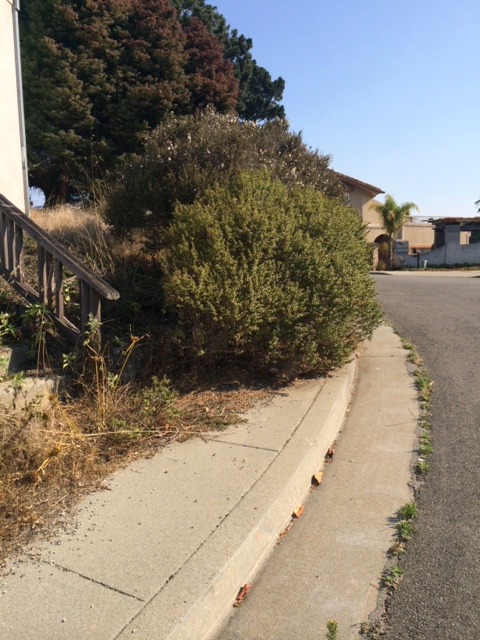 Clear Corner Visibility – When shrubs or tree branches interfere with vehicle operator visibility, trimming shrubs to a maximum height of thirty inches is required (30 inches maximum height, 25 feet minimum sight distance at corners), and trees must be pruned up to 8 feet above the sidewalk and 14 feet over the roadbed.
Walkway and Gutter Clearance – Trimming of ground cover or shrubs is required when there is an encroachment onto the sidewalk or gutter.
Obstacles in the Parkway Strip – Elimination of tree stumps, large rocks, trash, holes and some built-up planters is required. When the parkway strip is unimproved or landscaped and there is a drop, the parkway strip must be filled with dirt or other material (no asphalt) to eliminate tripping hazards.
When is concrete repair needed?
Repair of the sidewalk concrete is required in the following circumstances:
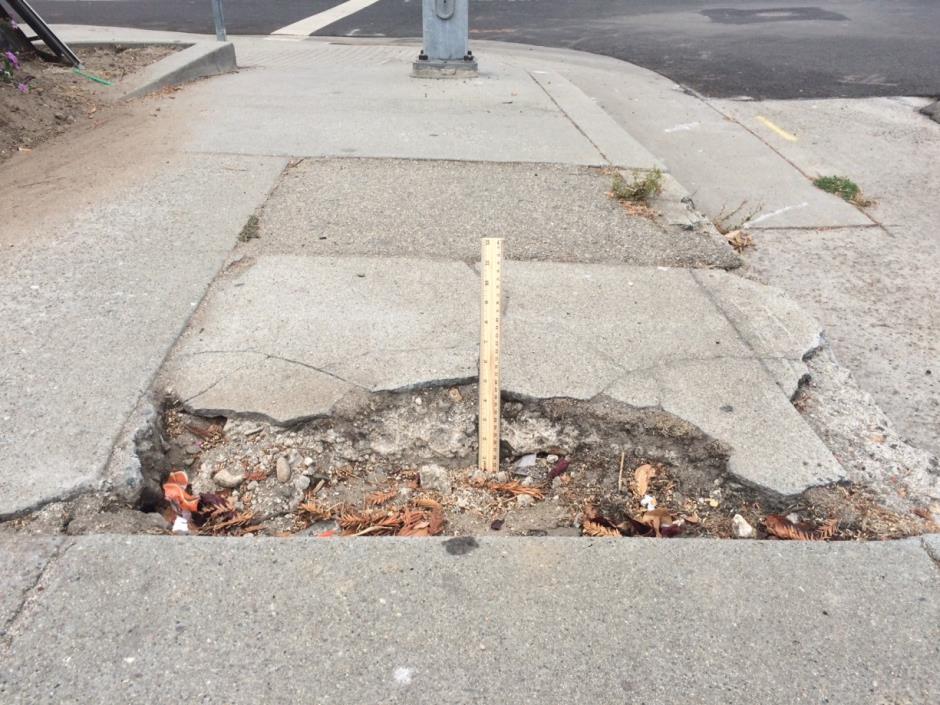
- A vertical separation of more than one-half inch in sidewalk or concrete park strip.
- Ramping, where there is a rise or depression of more than one inch within a horizontal distance of eight inches in conjunction with a vertical separation.
- A separation or opening in a break or construction joint of 3/8 inch or more (Americans with Disabilities Act Standard).
- The breaking apart or spalling of concrete with a minimum depth of more than one-half inch.
Curb and gutter repair is required in the following circumstances:
- Where a defect interferes with the safe and reasonable use by pedestrians and bicyclists, such as vertical or horizontal separations of more than one-half inch, or there are broken away sections adjacent to a marginal walk or driveway approach.
- It is part of a driveway approach replacement.
What are the options available for completing the work?
Construction of curbs, gutters, and sidewalks in City streets may be performed by a properly licensed and insured contractor. A permit is required for concrete repair, and may be issued to contractors. Permits for street tree and shrub trimming may be obtained from the Department of Parks and Recreation. Permits are valid for 45 days; call (831) 420-5270.
How does one go about finding a contractor?
The yellow pages or internet are good places to start. We recommend getting bids from at least three certified contractors. The contractor selected must secure a concrete construction permit from the Department of Public Works.
Are there inspections and standards for concrete repair work?
 Yes, all work and materials must be in conformance with the City of Santa Cruz Standard Specifications for Public Works Construction and Parks and Recreation ISA Standards.
Before placing any concrete you must have the forms, base, tree root removal, and saw cuts inspected. After approval, a City-approved concrete mix must be used. Finish must be a light broom finish with score marks to match the existing sidewalk. After the work is completed, you must call for a final inspection. A permit is required for all concrete work in the public right-of-way. To obtain a permit or arrange an inspection, call (831) 420-5160.
Is the property owner responsible for repairs if the concrete damage is caused by a tree?
In an effort to beautify our City’s neighborhoods, street trees are encouraged in front of each residence. The property owner is responsible for the maintenance of the street tree and for the cost of concrete repair, even though the concrete may have been raised by the street tree. Certain species of trees may raise concrete if preventative maintenance is not performed.
In extreme cases, street trees cannot be saved and must be removed before the sidewalk and/or curb and gutter can be replaced. City standards require replacement of the tree, to be selected from a list of approved street trees. Proper tree selection is critical and is reviewed by the City Arborist. The tree permit process in these cases must be pursued before a concrete permit can be issued. Tree permits are issued by the Parks and Recreation Department. Tree work permitting is governed by Chapter 13 of the Santa Cruz Municipal Code.
What measures should be taken to minimize concrete displacement by tree roots?
To reduce the chance of future concrete displacement, in some cases trees can be root-pruned and a root barrier installed where roots are parallel to the sidewalk. Root pruning and root barriers should be performed under the guidance of the City Arborist. Care must be taken when root pruning to avoid damaging underground utilities.
Also, deep-watering the tree, that is, applying a slow trickle of water over a 24-hour period, encourages deeper root growth which reduces the chance of sidewalk damage.
Contact Us
For further information about sidewalks and street trees please call:
Sidewalks
Public Works Department
(831) 420-5187
Street Trees
Department of Parks & Recreation
(831) 420-5270
About
About
A new street sweeping pilot program will launch in early 2025 to enhance street cleanliness and ensure compliance with state storm water regulations. Street sweeping is a vital service that removes debris and litter to enhance aesthetics, safety, and public and environmental health. The pilot will implement new "No Parking Zones" with new signage in several areas of our city. For inquiries, contact citypw@santacruzca.gov or 831-420-5160.
Background
For several years, the City has utilized a third party organization to monitor and test our streets for debris and trash in accordance with the Regional Water Quality Control Board Stormwater permit. We receive a “report card” for the effectiveness of our street sweeping program. While we're proud to report that most of our city shows low trash impacts, several areas were identified with “moderate trash levels.” These areas are primarily the Ocean Street corridor, Soquel Avenue and Water Street, the Harvey West area, and the far Westside, primarily Delaware and Mission Street Extension area.
Purpose
To optimize street cleaning efficiency, a pilot program will temporarily limit parking on alternate days from 5 AM to 7 AM. For example, on Tuesdays, parking will be restricted on the south side, and on Thursdays, on the north side. Some parking will still be available on the opposite side being swept. This arrangement facilitates unrestricted access for street sweepers to effectively clean curbside areas, streamlining the operation and ensuring compliance with stormwater regulations. To enforce access, "No Parking Tow Away" signs will be posted on existing sign posts throughout the pilot area.
The streets selected for the pilot not only have higher levels of litter but are also predominantly located in commercial areas, mitigating the impact of limited parking during the designated hours each week. The pilot program aims to evaluate how this approach could be implemented in residential areas with moderate litter levels and high parking demand.
Locations
Where and When
The pilot program has designated six zones based on the alternate side of the streets: Zones 1 and 2 cover the Harvey West area; Zones 3 and 4 encompass the Ocean, Soquel, and Water street corridors; and Zones 5 and 6 are situated on the far Westside in the Delaware area. While these areas are currently swept, usually on a weekly basis, parked cars often impede access to the curb and bike lane, where trash tends to accumulate. The map and list below details the specific streets affected and the number of parking spaces impacted during the designated two-hour period.
Program Enforcement
No parking in effect from 5-7 a.m. in the following zones. Vehicles found in violation after March 4, 2025 will be subject to citations and removal.
Street Sweeping Zones
View details about each street sweeping pilot program zone, including a detailed area map, below.
Zone 1 - Harvey West Area (Wednesdays - Green)
- Encinal from River Street to Du Bois St. (30 spaces)
- Du Bois St. to Harvey West Blvd. (23 spaces)
- Harvey West Blvd to Coral St. (58 spaces)
- Coral St. to River St. (68 spaces)
Zone 2 - Harvey West Area (Fridays - Red)
- Coral St. from River St. to Harvey West Blvd (30 spaces)
- Harvey West Blvd from Coral St.to Du Bois (61 spaces)
- Du Bois St. from Harvey West Blvd.to Encinal St. (30 spaces)
- Encinal to River Street (28 spaces)
Zone 3 - East Side Area (Tuesdays - Yellow)
- Ocean Street from Ocean St. Extension to Soquel Ave. (66 spaces)
- Soquel Ave to Morrissey Blvd. (80 spaces)
- Water St. from Morrissey Blvd. to North Branciforte Ave. (43 spaces)
Zone 4 - East Side Area (Thursdays - Blue)
- Water St. from Market Street. to Poplar Avenue (41 spaces)
- Soquel Ave from Poplar Ave to Ocean St. (46 spaces)
- Ocean Street from Soquel Ave. to Plymouth St. (50 spaces)
Zone 5 - West Side Area (Tuesdays -Yellow)
- Mission Street Extension from Swift Street to Natural Bridges Dr. (67 spaces)
- Natural Bridges Dr. to Delaware Ave. (80 spaces)
- Delaware Ave. from Shaffer Rd to Swift St. (140 spaces)
- Swanton Blvd from Delaware Ave to West Cliff Dr. (79 spaces)
Zone 6 - West Side Area (Thursdays - Blue)
- Natural Bridges Dr. from Delaware Ave. to Mission St. Extension (66 spaces)
- Mission St. from Western Dr. to Swift St. (77 spaces)
- Delaware Ave. From Swift St. to Shaffer Rd. (147 spaces)
- Swanton Blvd. from West Cliff Drive to Delaware Ave. (45 spaces)
Administrative Coastal Permit
Zones 5 and 6 are located in the coastal jurisdiction zone and require an administrative coastal permit, which was issued on April 17, 2024.
View larger map
Contact Us
Dan Estranero
Associate Professional Engineer
809 Center Street, Rm 201
Santa Cruz, California 95060
Phone: (831) 420-5189
Fax: (831) 420-5161
destranero@santacruzca.gov
Matthew Starkey
Transportation Manager
809 Center Street, Rm 201
Santa Cruz, California 95060
Phone: (831) 420-5182
Fax: (831) 420-5161
mstarkey@santacruzca.gov